
Every time a customer taps “pay now” on a website, a surprising amount happens in the couple of seconds before the confirmation appears. The technology that makes it possible is the payment gateway. If you have ever searched what is payment gateway, the short answer is that it is the secure link between your checkout and the banks involved in a card payment: it captures the customer’s details, encrypts them and passes them on for approval. An online payment gateway is now essential for any UK business that sells through a website, over the phone or by invoice. This guide explains how gateways work, what they do for you, what is the best payment gateway to choose, and what to look for if you need a high-risk payment gateway.
How Does a Payment Gateway Work?
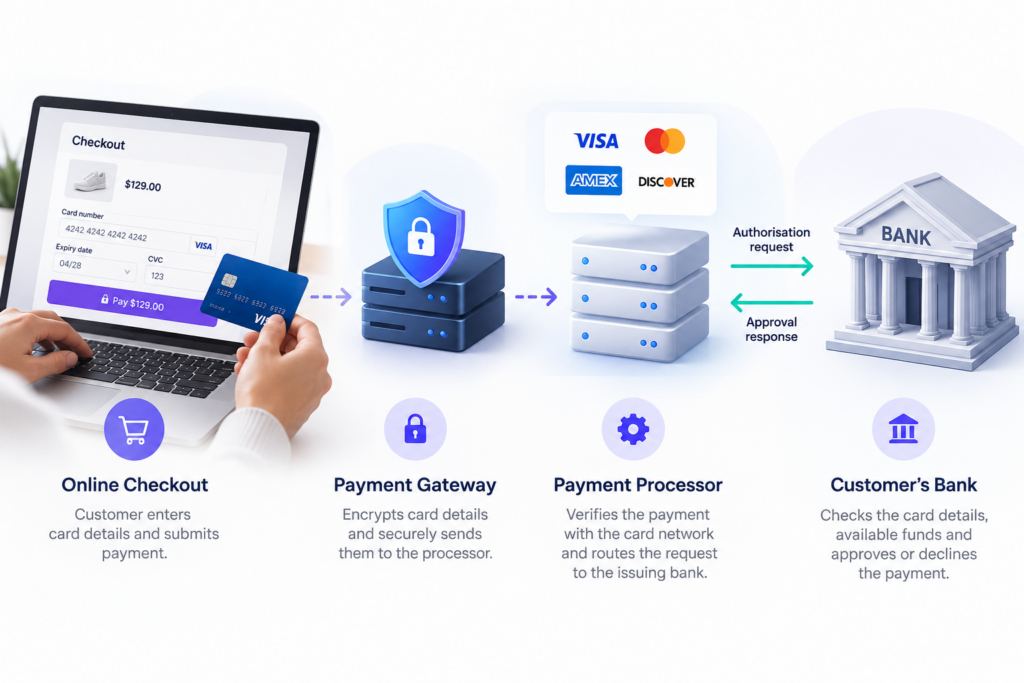
Think of a gateway as a card terminal for the internet. When a customer pays, the process runs roughly like this:
- The customer enters their card details at checkout, or opens a payment request you have sent them.
- The gateway encrypts the details and passes them to your payment processor.
- The processor routes the request through the card scheme (such as Visa or Mastercard) to the customer’s bank.
- The bank checks the available funds and fraud signals, then approves or declines the payment.
- The answer travels back to the gateway and your checkout in seconds. The money settles into your merchant account later, usually within a few working days.
It helps to keep three terms apart. The gateway transmits the payment securely, the processor moves it between banks, and the merchant account is where your funds land. Many providers bundle all three, which is often simpler for smaller firms.
Types of Online Payment Gateway
Gateways differ mainly in where the customer types their card details, and that affects both your branding and your security workload.
Hosted gateways
The customer is sent to the provider’s own payment page to pay. These are quick to set up and keep card data off your website, which reduces your compliance burden. The trade-off is less control over the look and feel.
Integrated gateways
The payment form sits on your site, usually through a plug-in or API, so customers never leave your brand. You get a smoother experience, but you take on more responsibility for security.
Pay by link and by phone
Not every sale happens at a checkout. A payment link lets you request payment by email, text or social message, while telephone payment solutions let your team take card details securely during a call. Both run through the same gateway, so the money is reconciled in one place.
Key Benefits of Using a Payment Gateway
The obvious gain is that you can accept card payments without handling card numbers yourself. Gateways encrypt data, replace card numbers with tokens and screen for fraud. They also manage the extra verification step that most UK online card payments now require, known as strong customer authentication, usually through 3D Secure.
A good gateway also widens how you can sell. Alongside cards you can offer Apple Pay and Google Pay, take payments in other currencies, and set up recurring payments for subscriptions, memberships and instalments. Reporting tools show every transaction, refund and chargeback, which makes reconciling your accounts much quicker. If you run a small firm, pairing a gateway with merchant services for small businesses keeps fees, contracts and support under one roof.
How to Choose the Best Payment Gateway
There is no universal winner. The right fit depends on what you sell, where your customers are and how you want to take payments. Compare providers on the following.
Fees and contract terms
Look beyond the headline rate. Check for setup fees, monthly charges, per-transaction costs, refund and chargeback fees, and minimum contract lengths. Ask for a quote that adds all of these together.
Compatibility and payment methods
Make sure the gateway works with your website platform, accounting software and any in-person payment setup. Confirm it supports the cards, wallets and currencies your customers use.
Security and support
Choose a provider that is compliant with PCI DSS, the industry standard for protecting card data, and offers fraud tools and 3D Secure. Check uptime history and whether UK-based support is available when something goes wrong.
High-risk businesses
Banks treat some sectors, such as travel, subscription services with frequent chargebacks, or CBD sales, as high-risk. Mainstream providers may decline these merchants, so specialist gateways exist, usually with higher fees and rolling reserves. Be upfront about your business model and compare chargeback terms carefully.
Conclusion
A payment gateway is the quiet engine behind every card payment you take away from the counter. It protects customer data, speeds up checkout, and lets you sell by website, link, phone, or subscription from one account. Compare fees, compatibility, and security before you commit, and be honest about your sector, because a high-risk payment gateway needs a different kind of provider from a standard one. If you are unsure which setup suits your business, Contact Us and our team will help you find the right fit.
Frequently Asked Questions
What is a payment gateway in simple terms?
It is the service that securely collects a customer’s card details at checkout and sends them to the bank for approval. Without it, you could not safely accept card payments on a website, over the phone or by link.
What is the difference between a payment gateway and a payment processor?
The gateway captures and encrypts the payment details, while the processor communicates with the banks to authorise the payment and move the money. Many providers offer both as one package.
Do I need a payment gateway for my small business?
If you take card payments online, by phone or through links, yes. A gateway is what makes those channels possible. If you only take payments in person, a card machine alone may be enough.
How much does a payment gateway cost?
Pricing varies. Providers usually charge some mix of a monthly fee, a per-transaction fee and a percentage of each sale. Compare quotes on a like-for-like basis using your expected monthly volume.
Can I take card payments without a website?
Yes. A payment link or a virtual terminal for phone orders lets you take payments without running an online shop, as both use the gateway behind the scenes.
